






Electric or Manual Toothbrush: Why It Does (and Doesn't) Matter
January 28th, 2026
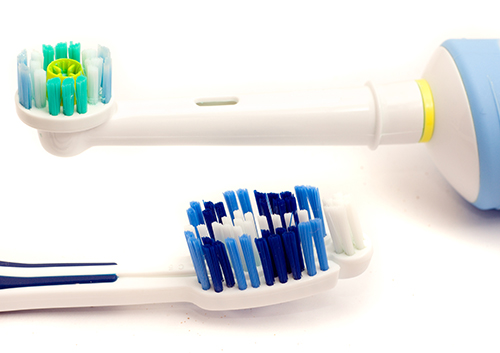
You live in the golden age of toothbrushes. Until a few decades people used twigs or brushes made from animal hair to clean their teeth: not very soft and none too effective.
Now, you have a choice of manual brushes with soft, medium, or hard bristles. Or you might choose to go with an electric toothbrush instead.
Have you ever wondered whether manual or electric brushes provide better cleaning? Actually, they both do the job. The key is to brush and floss every day, regardless of the kind of brush you prefer.
At our Highland, IN office, we like to say the best brush is the one you'll use. So if you prefer manual, go for it. If you prefer electric, turn it on.
Both types have their advantages but both types will get the job done as far as removing plaque.
Electric Toothbrushes
- Provide power rotation that helps loosen plaque
- Are great for people with limited dexterity due to arthritis or other problems
- Are popular with kids who think the electric brushes are more fun to use
- Can come with variable speeds to help reduce pressure on sensitive teeth and gums
Manual Toothbrushes
- Can help brushers feel they have more control over the brushing process
- Allow brushers to respond to twinges and reduce the pressure applied to sensitive teeth and gums
- Are more convenient for packing when traveling
- Manual brushes are cheaper and easier to replace than the electric versions.
In many ways, the golden age is just beginning. There are already phone apps available to remind you to brush and floss. New apps can play two minutes worth of music while you brush, help you compare the brightness of your smile or help explain dental procedures. Maybe someday we’ll even have programs that examine your teeth after brushing and identify spots you might have missed.
Bright Ideas for Your Smile
January 21st, 2026

Keeping your smile its brightest can be a challenge! The foods you eat, healthy habits, unhealthy habits, and time itself can affect the color of your enamel. Luckily, there are some everyday actions you can take to minimize staining and discoloration.
- Limit “Food Coloring”
Some of our favorite foods and beverages cause some of the most noticeable staining. Even though enamel is the strongest substance in our bodies, it’s still porous. This means that enamel can absorb elements from our foods, including tannins and natural food colors, which darken teeth over time.
That’s why a daily cup of coffee or tea, or a glass of red wine with dinner, or frequent helpings of dark berries, can lead to a less than brilliant smile in a matter of months. What’s more, acidic foods like citrus fruits, pickled foods, and sodas erode the enamel surface, which makes it easier for food stains to penetrate.
When you eat those smile-dimming foods, it’s a good idea to rinse with water right away. (When tasty treats are acidic, it’s best to wait to brush for about half an hour to avoid enamel damage.) And here’s a simple work-around—use a straw when you enjoy discoloring drinks.
You can also reduce staining by adding food allies to your diet. Besides bringing you the nutritional benefits of a healthy, well-balanced diet, crunchy foods such as apples, carrots, and celery can have a mild scrubbing effect on the tooth surface, and dairy foods strengthen enamel and might help prevent staining when added to coffee or tea.
If you’re mindful of your eating habits, you’ll help your smile stay its brightest. And speaking of habits . . .
- Keep Up with Healthy Habits
Plaque is a sticky biofilm which contains oral bacteria, food particles, saliva, and fluids. This film starts forming within hours after brushing, and a buildup of plaque leaves teeth looking yellowish. If plaque is left undisturbed, it hardens into tartar within days. And the yellow and brown colors of tartar aren’t a flattering look for any of us.
Regular brushing and flossing is the best way to keep your teeth plaque-free. For a brighter smile, a whitening toothpaste can help remove superficial surface stains. But what a whitening toothpaste can’t do is to remove deep staining or tartar.
A professional cleaning every time you have a checkup at our Highland, IN office is the best way to keep your teeth their cleanest, especially because tartar must be removed by a dental professional. And please feel free to ask for brushing and flossing tips to help maintain your sparkling smile.
- Give Up Unhealthy Habits
Cigarettes, cigars, and other forms of tobacco are terrible for your health and terrible for your smile. While cosmetic concerns are the least of our worries when it comes to tobacco, it’s well known that smoking and chewing tobacco cause unattractive yellow and brown staining.
Quitting tobacco in any form benefits not just your appearance, but your oral health—and your overall health. When you’re ready, talk to Dr. Rick Johns about some of the methods you can use to give up the habit permanently.
- Beat the Clock
Over the years, erosion and wear cause the enamel layer on the outside of the tooth to thin or crack. This allows the dentin underneath to show through. Because dentin is darker than enamel to begin with, and gets darker over time, teeth can take on a yellow or grey hue as we age.
Keep your smile looking its best through the years with regular checkups and cleanings. Avoid excessive erosion and abrasion by being mindful of the acidic foods in your diet, using a soft-bristled brush for cleaning your teeth, and getting treatment for harmful conditions like bruxism (tooth grinding). If you notice any changes in your smile, it’s a good idea to talk to Dr. Rick Johns.
While preventing staining naturally with diet and healthy habits is great, sometimes nature needs a nudge. If you have an important event coming up, or if you would simply like to feel more confident about your smile, talk to us about professional whitening. A professional treatment uses a stronger whitening formula, and often works more quickly, is more effective at removing yellowing and stains, and lasts longer than home treatments.
Finally, while you can do a lot to keep your teeth their brightest by preventing and treating external staining, other types of discoloration can also affect your teeth. For staining caused by medication, root canal work, or trauma, ask us about all the options available to you.
Yes, keeping your teeth their brightest can be a challenge, but doing your part—and working with your dental team at Rick Johns Dental—will make sure you greet the world with a sparkling, confident smile.
Canker sores, cold sores, and mouth sores: What's the difference?
January 14th, 2026

At Rick Johns Dental, we know many people have experienced some form of mouth sores or irritation. Some mouth sores are harmless and go away on their own after a few days, while others are more serious and should not be ignored. Mouth sores occur for many different reasons, but bacterial infections, viruses, or funguses often trigger them. The best way to tell the difference between a canker sore and a cold sore is that canker sores occur inside the mouth while cold sores occur on the outside the mouth.
The most common mouth sores are:
Canker sores: A non-contagious, small, grayish ulcer with a red border, canker sores appear inside the mouth. While outside factors such as stress, fatigue, or allergies may increase the chances of developing a canker sore, most health experts believe they stem from bacteria or a virus that attacks the immune system. Canker sores typically heal within a week or two.
Cold sores: Also called fever blisters, cold sores are contagious groups of fluid-filled blisters that often erupt around the lips and sometimes under the nose or around the chin. Cold sores are the result of the herpes simplex virus, and once infected, the virus remains in the person’s blood stream.
Leukoplakia: A potential warning sign of oral cancer, leukoplakia is a premalignant lesion that appears as a white patch on the inside of the mouth, tongue, or gums. The lesions, which are caused by excessive cell growth, usually afflict those who smoke tobacco. Dr. Rick Johns may choose to have the lesion biopsied if the outbreak appears severe.
Oral candidiasis: Also called oral thrush or moniliasis, this condition is caused by the overgrowth of a type of yeast called candida. Common symptoms of oral candidiasis include white spots inside the mouth and on the tongue, redness or discomfort in the mouth area, sore throat,difficulty swallowing, and cracking at the corners of the mouth. It is important to visit Dr. Rick Johns if you have oral candidiasis. If left untreated, it may infect your bloodstream, which can be very dangerous. Healthy adults do not usually get thrush, and the condition is most often seen in infants, the elderly, patients undergoing chemotherapy, or people with AIDS or other diseases that are known to weaken the immune system.
Should you have a mouth sore that lasts a week or longer, we encourage you to give us a call and schedule an examination at our Highland, IN office.
Digital X-rays
January 7th, 2026

X-rays are a vital diagnostic tool for any dental professional. X-rays help your endodontist perform a root canal, your orthodontist check the position of a tooth’s root, your oral surgeon discover a fracture. X-rays reveal what we can’t see with the naked eye—and that’s why they are an especially important tool for Dr. Rick Johns as well.
Why Are X-rays Necessary?
There’s a lot going on below the surface. An X-ray can reveal such conditions as cavities between teeth or underneath fillings, abscesses and other infections in the bone, impacted wisdom teeth, and cysts and tumors. They can also show the size, shape, and density of the bone beneath the teeth, which is essential information for dental implant procedures or dentures.
How Do X-rays Work?
Traditional X-rays, or radiographs, make use of film just like traditional cameras. When you have an intraoral X-ray, for example, the film is sealed in a moisture- and light-proof packet, and placed inside the mouth to capture images of specific teeth and the bone around them.
The X-ray machine is aligned precisely with the film and an exposure is taken. The image at this point is latent, and won’t show on the film, because, just like photo film, traditional radiographs need to be chemically processed before they produce a visible image.
Digital technology, on the other hand, uses an electronic sensor instead of film. For an intraoral digital X-ray, a small sensor is positioned in the mouth just like a film. When the X-ray is taken, a digital image capture device produces an image which is formed by a matrix of pixels instead of a photo-like film exposure. This format allows the image to be sent directly to a computer for immediate display without requiring processing.
Even though these methods seem very similar, digital X-rays offer some significant advantages over traditional films. Let’s look at how they compare, more or less.
- More Diagnostic Advantages
A traditional X-ray is a fixed image. It cannot be modified or enhanced. Here the digital X-ray offers a clear advantage in diagnosis.
Just as you can enlarge certain types of images on your computer without blurring or losing detail, a digital X-ray uses computer software to magnify images while keeping their details sharp. They can also be enhanced through brightness and contrast applications to make details stand out even more. Both of these benefits are extremely helpful for diagnosis, especially when looking for small cavities, problems in the roots and surrounding bone, or developing wisdom teeth.
There is even digital subtraction radiography software available that can be used to compare recent images to older ones, removing (“subtracting”) all the similarities in the two images to display only the changes in the two—even small changes—that have taken place over time.
- Less Exposure to Radiation
Dental X-rays expose patients to very low levels of radiation, and modern technology means traditional X-rays expose patients to less radiation than ever before. Even so, digital X-rays have significant advantages. Radiation exposure can be reduced by an additional 10%, 20%, or more with a digital radiograph.
- More Convenient for Sharing and Transmitting
If you need to share your X-rays with another dental specialist or physician, digital technology allows you to simply have them e-mailed to another office or multiple offices. You no longer need to worry about preserving physical copies, either.
- Less Waste
Unlike traditional X-rays, digital X-rays don’t need to be processed, so you save time in the office. And while the processing time is not significant (usually several minutes), if you need to repeat some X-rays for a clearer picture, or require different images for several teeth, this time can add up.
Digital X-rays are also more eco-friendly. The fact that they don’t need to be developed means that the chemicals used to process traditional films are no longer necessary—which also means that there is no need to dispose of chemical waste products afterward.
Our goal is to provide you with the safest, most efficient, and most effective dental treatment possible, and digital X-rays help us do that. If you have any questions about digital X-ray technology, contact our Highland, IN office. We’re happy to explain the science—and the benefits—of high-tech radiography.