






Are dental X-rays safe?
January 31st, 2017

YES! X-rays have been used in dentistry for a long time, and the amount of radiation has significantly decreased with advances in technology. While there is risk in every health diagnostic procedure at Rick Johns Dental, the benefits must outweigh the risks. Dental X-rays do indeed fall into this category.
X-rays are exposed to a type of film to produce an image. The amount of X-rays required to produce this image differs with film speeds. Speed E or F is highly recommended, and digital X-rays require up to 50% less than speed E or F film. The digital X-ray software can adjust the exposure to produce a quality image. Digital X-rays are becoming a new standard and are most common.
Lead aprons have been used to reduce the amount of scatter radiation. All X-ray units have a cone to focus the X-ray beam so the exposure is highly localized. Lead aprons continue to be worn as a precaution for pregnant women, and a thyroid collar should also be worn. In most cases, this is sewn into the lead apron.
We get radiation exposure from environmental factors as well as healthcare diagnostic and treatment tools. To place this in perspective, in one year a person is expected to have 360mRem per year from the sun, air etc. By comparison, a single set of bitewing X-rays is 0.3mRem. Radiation can accumulate in our body over a lifetime, and additional exposure should be avoided whenever possible.
What are dental sealants and how do they work?
January 25th, 2017

A dental sealant is a liquid that is applied to the teeth. The sealant hardens and provides a protective coating that is designed to reduce cavities and create a smoother tooth surface. Dental sealants are clear or white; they do not take away from the appearance of teeth. You can think about this treatment as being similar to varnish that protects a wood floor.
Sealants are not the same as fluoride treatments. The application is similar, but sealants are a semi-permanent protective coating. Dr. Rick Johns and our staff recommend that sealant applications for children begin soon after molars erupt, first molars around the age of six, and second molars around the age of 12.
Simple Application
Having sealants applied is not uncomfortable at all. First, your child's teeth will be cleaned and dried. A gel is applied, which helps the sealant adhere to the tooth, and then is rinsed away. Your child's teeth are dried again and the sealant is applied. A few seconds of exposure to a light source may be used to cure the sealant and make it semi-permanent. Sealants should last for a long time, normally between five and ten years.
Sealant Benefits
The coating on the surface of your child's teeth reduces the amount of acid contact. Normal acids in foods that are consumed can eat away at the surface of teeth. Bacteria also react to plaque formation and create more acid in the mouth. These small pits or weakened areas are prone to caries or cavity formation. Preventing cavities is a much better choice than drilling and filling damaged teeth.
A sealant also helps to smooth the chewing surfaces of your childn't teeth. The smoother surface is not as likely to retain small particles of food and bacteria. Your child's mouth stays cleaner and food is not left behind to form acids. The protective application can also be used on other teeth that have a rough surface, to protect the grooves or pits from decay.
After the sealant is applied, your child still needs to take proper care of his or her teeth. Regular brushing and flossing is required. Dr. Rick Johns may recommend fluoride treatments to strengthen and protect your child's teeth further.
If you have any concerns about sealants, please discuss them with during your child's next appointment at Rick Johns Dental. We want your little one's teeth to stay healthy for life.
Why Visiting the Emergency Room for Your Dental Problem isn’t a Good Idea
January 17th, 2017

Emergency rooms are for emergencies, so before you head to the hospital because of a dental problem, you need to ask yourself this question: Is what you're experiencing really a medical emergency? While emergency room visits for dental related issues are on the rise across the United States , they’re not necessarily the best solution for every problem. Many people don't know about emergency dental care services, many of which are available 24/7, and so they go to the ER.
These types of statistics are common across the country. However, despite the numbers, not all dental problems are created equal. If you've experienced some type of injury to your mouth, jaw, or face, then an ER visit is a good idea, but if you're suffering from a toothache, cavity, or broken crown or veneer, then the ER is not the best place to handle the situation. If you're having a dental emergency, then seeking emergency dental care should be your course of action.
Seeking Long-Term Solutions
The ER doesn't provide a long-term solution to your dental issue; it only gives you temporary relief. There’s a chance they will simply hand you a prescription for pain medication and tell you to call your dentist in the morning. In the end, you’re going to be saddled with two medical bills, and nobody wants that. Even if the ER outfits you with a temporary crown or filling, you're still going to have to make a follow-up appointment our office.
There are numerous homemade remedies that can sooth tooth and gum pain. However, if you're experiencing a dental emergency, the ER is not the place to go. The specialized emergency team at Rick Johns Dental is available to take care of every dental problem you may have. In the case of a dental emergency, don't wait any longer than necessary. Feel free to contact our Highland, IN office at any time, day or night.
Mouthguard Q&A
January 10th, 2017
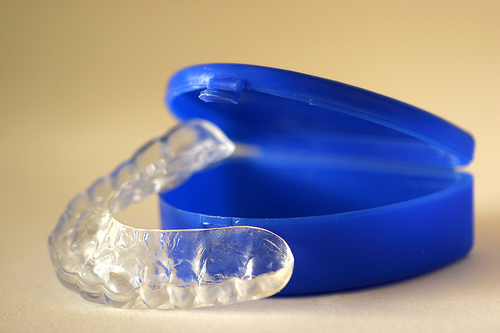
Today, Dr. Rick Johns and our team at Rick Johns Dental thought we would talk about mouthguards, what they are, where to get them, and when to use them.
Q: What is a mouthguard?
A: A mouthguard, which is made of soft plastic, is a flexible, removable device that fits in your mouth and is adapted to fit comfortably to the shape of your upper teeth. A mouthguard will protect not only the teeth, but also your jaws, lips, tongue, cheeks, and gums, and should be worn anytime you are participating in full-contact athletic or recreational activities that may result in injury.
Q: How do mouthguards work? Why are mouthguards important?
A: A mouthguard works as a shock absorber to cushion your mouth from the effects of a blow to the face, head, or neck. Mouthguards protect teeth from not only fractures, but also hold the tongue, lips, and cheeks away from the teeth to avoid lacerations. Using a mouthguard as instructed by Dr. Rick Johns can lessen the possibility of concussion and temporomandibular joint (TMJ) dislocation while you are out on the court or field. Increasingly, organized sports are requiring mouthguards to prevent injury to athletes, and research shows most mouth injuries occur when athletes are not wearing mouth protection.
Q: When should I wear a mouthguard?
A: Whenever you are participating in an activity that involves a risk of falling or head contact with other players. This includes football, baseball, basketball, soccer, hockey, and other competitive sports.
Q: How do I choose a mouthguard?
A: Dr. Rick Johns and our team encourage you to choose a mouthguard that you can wear comfortably. There are several options of mouthguards you may choose from. First, preformed or what we call “boil-to-fit” mouthguards are found in sports stores. But your best choice is asking us for one during your next visit as we can fabricate a custom mouthguard for you at our Highland, IN office. A custom mouthguard will be more comfortable to wear and more effective in preventing injuries.
If you have any additional questions about mouthguards, please give us a call or ask us during your next visit!
