






What kind of toothbrush and toothpaste should my child use?
December 1st, 2021
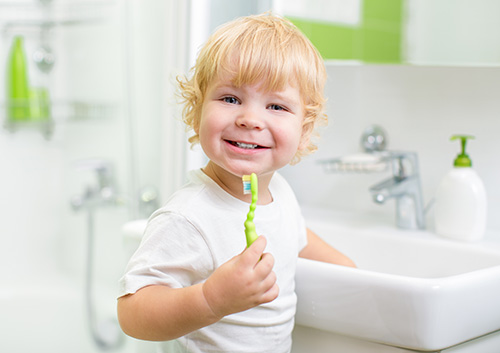
Dr. Rick Johns and our team know that as a parent, you want your child to be as healthy as possible. By now, you probably know that your son or daughter’s oral health plays a huge role in overall health.
When there are so many toothpaste ads and different styles of brush to choose from, it can be difficult to know which will serve your child the best. We recommend you break down the decision process to make it simpler.
First, your child’s age and stage of development are vital to consider. Until about the age or 12, your youngster may not be prepared to brush or floss adequately alone, due to dexterity issues. If that’s the case, it can be easier to use a battery-powered toothbrush to improve the quality of brushing.
Next is to select the right size of toothbrush head to fit your child’s mouth. As a general rule, the head of the toothbrush should be a little larger than the upper portion of the child’s thumb.
Flossers are great for children and easy to use. They have handles and a horseshoe shape on one end with floss in between. Your child can choose a color he or she likes as well as the handle size, shape, etc.
Not only are there many brands of toothpaste to choose from, there are also many different ingredients that offer varying benefits. Kids are at high risk for developing cavities so you want to make sure the following ingredients are in your child’s toothpaste if you wish to avoid problems later on.
Sodium fluoride is the standard ingredient for cavity prevention, while stannous fluoride is anti-bacterial and anti-cavity. Anti-sensitivity toothpastes often contain potassium nitrate, and triclosan can be found in one particular brand for anti-bacterial action.
Fluoride should not be ingested, so if your child can’t spit yet, use a toothpaste that contains xylitol. This is a natural sweetener and should be the first ingredient listed on the tube.
Now comes the fun part: choosing a flavor! Your little one may sample different flavors and select the one he or she likes the best. A youngster is more likely to adopt good brushing habits if the flavor is appealing.
Don’t hesitate to speak with Dr. Rick Johns if you need to make an appointment at our Highland, IN office, or if you have any questions about toothpastes or toothbrushes.
Thanksgiving Trivia
November 24th, 2021

At Rick Johns Dental we love learning trivia and interesting facts about Thanksgiving! This year, Dr. Rick Johns wanted to share some trivia that might help you feel a bit smarter at the holiday dinner table and help create some great conversation with friends and family.
The Turkey
There is no historical evidence that turkey was eaten at the first Thanksgiving dinner. It was a three-day party shared by the Wamponoag Indians and the pilgrims in 1621. Historians say they likely ate venison and seafood.
According to National Geographic, the dinner at the Plymouth colony was in October and included about 50 English colonists and 90 American Indian men. The first Thanksgiving dinner could have included corn, geese, and pumpkin.
Today, turkey is the meat of choice. According to the National Turkey Association, about 690 million pounds of turkey are consumed during Thanksgiving, or about 46 million turkeys.
The Side Dishes
The green bean casserole became popular about 50 years ago. Created by the Campbell Soup Company, it remains a popular side dish. According to Campbell’s, it was developed when the company was creating an annual holiday cookbook. The company now sells about $20 million worth of cream of mushroom soup each year, which is a major part of the recipe.
While there were likely plenty of cranberries for the pilgrims and Indians to enjoy, sugar was a luxury. What we know today as cranberry sauce was not around in those early Thanksgiving days. About 750 million pounds of cranberries are produced each year in the US, with about 30 percent consumed on Thanksgiving.
The Parade
Since Thanksgiving did not become a national holiday until Lincoln declared it in 1863, the annual parades were not yearly events until much later. The biggest parade that continues to draw crowds is the Macy's Thanksgiving Day Parade. Beginning in 1924 with about 400 employees, they marched from Convent Avenue to 145th Street in New York City. Famous for the huge hot-air balloons today, it was actually live animals borrowed from the Central Park Zoo that were the stars of the show then.
However you choose to spend your Thanksgiving holiday, we wish you a safe, happy and healthy holiday with those you love.
Root Canal Recovery
November 17th, 2021

Anyone who has had a compromised tooth knows that the amount of discomfort it causes can be extremely unpleasant. Although no one looks forward to a root canal, this procedure is actually the best way to both eliminate pain and save your tooth. If the pulp inside your tooth is infected or damaged, a root canal is probably necessary.
The process is relatively straightforward and can take place over one or two visits to our Highland, IN office. The area around the tooth is numbed, the pulp is removed from the inside of the tooth, the area is thoroughly cleaned, and a temporary filling or crown is placed on the tooth to prevent bacteria and food from entering the site. A permanent crown will be fabricated and affixed to the tooth at a later visit.
Once your root canal is finished, recovery is usually only a matter of days. What can you to keep yourself as comfortable as possible during that time?
- The area around the affected tooth might be somewhat sore or sensitive for a few days. Let us know, and we can talk about medication to reduce pain and inflammation. If you are prescribed antibiotics, be sure to take the entire course of medication as directed.
- Taking an ibuprofen (if this is a pain reliever that is safe for you) before the anesthetic wears off will reduce the soreness in the hours immediately after the procedure.
- Wait until the numbness is gone before eating to avoid biting down on a temporary filling (or your tongue). Hot drinks are also best avoided.
- Avoid chewing on the side of the affected tooth until the restoration is complete. A soft diet is recommended for the first several days—chewy, sticky, and crunchy foods should wait.
- Continue with regular brushing and flossing.
- Call Dr. Rick Johns immediately if you experience severe pain or visible swelling, if you have an allergic response to medication, if your bite feels uneven, or if you lose the temporary filling.
Follow the instructions we’ll give you carefully, and feel free to call us with any concerns. We want to ensure that your root canal is as pain-free and worry-free as possible.
Smile! It’s Time for Arts & Crafts!
November 10th, 2021

If you have a child who loves arts and crafts, try some of these creative projects with a dental twist. One of these activities is sure to give your child something to smile about!
Toothbrush Art
Why throw away that used toothbrush when you can help your young child make art with it? Give it one more cleaning and a second life. The easy-to-grip handle and the wide bristles make a toothbrush easy for young hands to hold and paint with. If you are in an adventurous mood, use the brush to make splatter art. Your child can splatter an entire sheet of paper for an abstract effect, make a sky full of stars with a flick of the brush, or add splatter leaves to a tree scene. Cut out a stencil with a favorite shape (an animal, a flower, a toy), place it on a sheet of paper, splatter around it, remove the cutout, and—instant silhouette!
Paper Crafts
If your child is an origami enthusiast, there are some challenging dental-themed examples available online. These might be too advanced for beginners, but more experienced origami fans can make molars with roots and even molars lined with pink paper to symbolize the interior pulp. Younger paper artists might enjoy making construction paper models of an actual tooth, with white enamel, yellow dentin, and pink pulp layered in their proper order.
Sculpting Fun
For the scientifically minded young artist, clay can be used to make a 3D model of a tooth, with different colored clays representing the different layers of the tooth. Younger children learning about their teeth might enjoy fitting little white clay teeth into a pink clay crescent to show how baby (or adult) teeth fit into the gums. And for non-dental inspiration, old, clean toothbrushes can once again help out if your child likes sculpting art work with modeling clay. Add interesting texture by using the brush bristles on damp clay to create grooves, lines, or indentations.
Welcome the Tooth Fairy
If the Tooth Fairy is a regular visitor, make her welcome with a box decorated with paint or fabric to hold that special baby tooth. Or craft a pouch or a bag with fabrics scraps, and add a fabric tooth so that the Tooth Fairy will know she has come to the right spot. If you use felt and fabric glue, no sewing necessary! If your Tooth Fairy is an under-the-pillow traditionalist, decorate an envelope with a letter to the Tooth Fairy inside.
If some of these projects sound just right for your child, check out online craft sites for even more ideas. And, please be sure to have your children show and tell the next time they visit our Highland, IN office. That will put a smile on our faces!
